A modern slot machine works by running a random number generator (RNG) that picks the result of each spin the instant you press the button. The spinning reels only display an outcome that has already been chosen, and the game’s pay table is set so that over millions of spins it pays back a fixed share of what is wagered.
That is the short answer. Below, we walk through each step, show how the odds are built, and explain what return to player (RTP) means for a session. If you want to see randomness in action while you read, try our free Plinko game or browse every title in the Blitz games lobby. Blitz coins have no cash value, so you can test ideas without risk.
How a slot spin works
- Bet. You choose a stake and press spin.
- RNG pick. The chip draws a number for each reel.
- Map. Each number maps to a reel stop and symbol.
- Show. The reels animate and stop on the chosen symbols.
- Pay. The pay table decides what, if anything, you win.
Source: Wikipedia, “Slot machine”; Engines of Our Ingenuity, episode 2740. Outcome counts computed by Blitz.
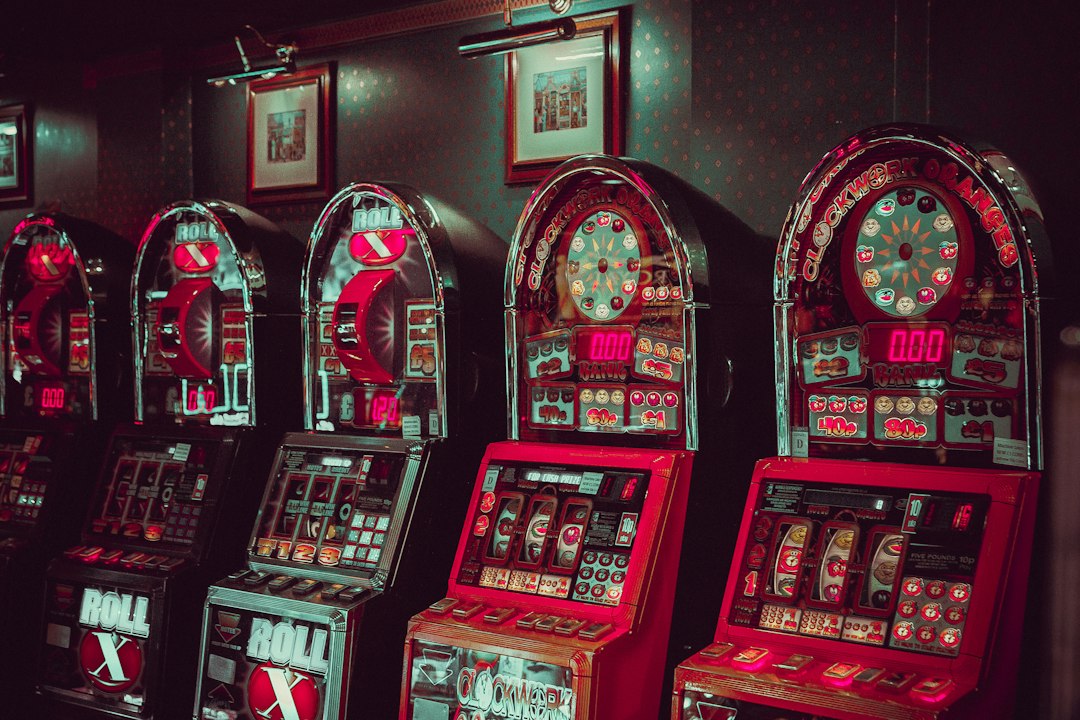
Step 1: the random number generator decides
Inside every modern slot is a random number generator, a chip or piece of software that produces numbers with no pattern a player can predict. When you press spin, the game takes the current numbers and uses them to choose where each reel will stop.
Nevada’s gaming rules define randomness as “the observed unpredictability and absence of pattern in a set of elements or events that have definite probabilities of occurrence.” The key phrase is definite probabilities: each result is unpredictable, but the long-run chance of every combination is fixed by design.
Step 2: numbers map to reel stops (the virtual reel)
On the first mechanical slots, odds came straight from the physical reels. Three reels with 12 symbols each give 12 × 12 × 12 = 1,728 combinations, so one cherry per reel means three cherries land once in 1,728 spins on average.
That changed with a patent granted on May 15, 1984 to Inge Telnaes of Reno, Nevada (US 4,448,419), for an “electronic gaming device utilizing a random number generator for selecting the reel stop positions.” The idea: the RNG picks from a long list of virtual stops, and several virtual stops can point to the same physical symbol. A reel with 256 virtual stops gives 256 × 256 × 256 = 16,777,216 possible results across three reels.
Here is what that does to the odds in a simple example. Suppose a physical reel has 22 stops and the top symbol sits on one of them. If the reel were purely mechanical, three top symbols would come up once in 10,648 spins. Map that symbol to just one of 64 virtual stops instead and the chance drops to once in 262,144 spins, about 24.6 times rarer, even though the reel you see looks the same.
| Reel setup (3 reels) | Stops per reel | Total combinations | Chance of one specific line |
|---|---|---|---|
| Small mechanical reel | 12 | 1,728 | 1 in 1,728 |
| Mechanical reel | 20 | 8,000 | 1 in 8,000 |
| Mechanical reel | 22 | 10,648 | 1 in 10,648 |
| Virtual reel | 64 | 262,144 | 1 in 262,144 |
| Virtual reel | 256 | 16,777,216 | 1 in 16,777,216 |
Step 3: the pay table sets the return to player
Once the probabilities are fixed, the designer writes a pay table: how much each winning combination pays. Multiply each win by its chance, add them up, and you get the game’s return to player. Manufacturers record these numbers in a document called the Probability and Accounting Report, or PAR sheet.
States set floors. Nevada requires a minimum payback of 75%, New Jersey 83% and Mississippi 80%. Real machines usually pay more than the floor. A January 2026 Las Vegas Review-Journal report on a UNLV Center for Gaming Research study said that in practice Nevada’s split is “closer to 93.5 percent-to-6.5 percent.”
RTP is a long-run average, not a promise for one session. Here is what each figure means on average for every 100 coins wagered:
- 75% RTP: an expected loss of 25 coins per 100 wagered (125 coins over 500 one-coin spins).
- 80% RTP: 20 coins per 100 (100 over 500 spins).
- 83% RTP: 17 coins per 100 (85 over 500 spins).
- 93.5% RTP: 6.5 coins per 100 (32.5 over 500 spins).
Step 4: the reels put on a show
The spinning, the slowing reel and the near miss are presentation. By the time the first reel stops, the result is already set. Stopping the reels early with a second button press changes the animation, not the outcome.
Common mistakes about how slots work
- “This machine is due to hit.” Each spin is independent. A long dry spell does not make the next spin more likely to win. Our guide to blackjack myths covers the same trap at the card table.
- “I can see the odds on the reels.” With virtual reels, the symbols you see do not show how often each one lands.
- “Near misses mean I am close.” A jackpot symbol just above the line is not a sign that a win is coming.
- “High RTP means I will win today.” RTP describes millions of spins. Short sessions swing widely in both directions.
- “Timing my press changes the result.” The result is set by the RNG when the spin starts, not by how you press the button.
A short history of the machine
Charles Fey, a San Francisco mechanic, built the three-reel Liberty Bell in the late 1800s; sources give dates from 1887 to 1899. In 1963 Bally released Money Honey, the first fully electromechanical slot, with a bottomless hopper that paid up to 500 coins without an attendant. The first video slot followed in 1976, built by Las Vegas-based Fortune Coin Co. Read how the classic symbols came about in how the slot machine got its cherries and 7s.
Practice it now
The best way to feel how a fixed RTP plays out is to watch results pile up. Drop a few hundred balls in our free Plinko game, then compare short runs with the long-run figure. For more probability basics, read is Plinko luck or skill?
FAQ
Are slot machines random?
Yes. Each spin’s result comes from a random number generator, and every combination has a fixed probability set by the game’s design.
What is a virtual reel?
A list of numbered stops, often far longer than the physical reel, that the RNG picks from. Several virtual stops can map to the same symbol, which lets designers make some symbols much rarer than they look.
What does RTP mean on a slot machine?
Return to player is the share of all money wagered that the game pays back over the long run. A 93.5% RTP means an average loss of 6.5 per 100 wagered.
Can a casino change the odds on a single machine?
Payback is set by the game’s program, and each state’s rules set limits, such as Nevada’s 75% minimum.
Can I win real money playing slots on Blitz?
No. Blitz is a free social casino and coins have no cash value. If gambling stops being fun, see our responsible gaming page or call 1-800-MY-RESET.